Open Ephys AcqBoard

This module streams electrophysiology data from the Open Ephys Acquisition Board Gen2 and Gen3. Check out Differences Between Generations to see which hardware you have.
Usage
The settings dialog is split into three groups:
- Backend — choose between the real hardware (Open Ephys Acquisition Board), or Simulated. The currently active backend is displayed next to the selector; the Reconnect button re-probes the bus, which is useful after plugging the board in.
- Acquisition — sample rate (the available rates depend on the
backend), and optional streaming of the per-headstage AUX channels
(3 per headstage) and the board’s eight on-board ADC inputs. The
channel naming scheme (Global index
CH1, CH2, ...versus Stream-relativeA1_CH1, A1_CH2, ...) is also set here. - Headstages — summary of currently detected headstages and their active channel counts. The Measure impedances… action runs the board’s on-chip impedance scan and updates the per-channel readout.
Per-channel masking is available in the channel inventory: any channel disabled there is dropped from the corresponding output port. During a run, toggling a still-enabled channel mutes its column (zero-fill) for the rest of the run — useful for isolating noisy channels live without restarting acquisition.
The module also accepts a TTL trigger input port: connect an upstream
module that emits LineCommand events, and the module fires the
board’s digital output lines accordingly. Only WriteDigitalPulse
commands on lines 0–15 are honoured; other command kinds are ignored.
Wiring example
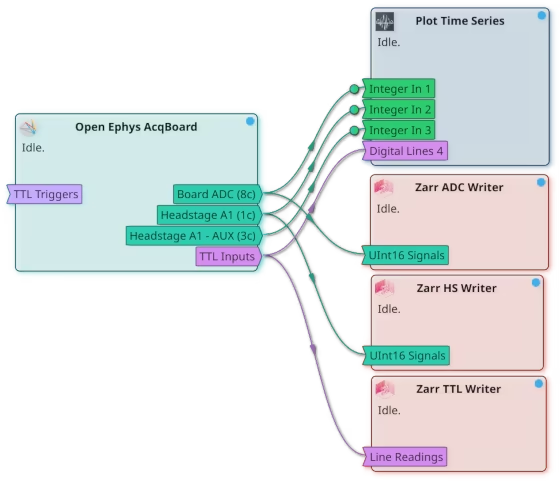
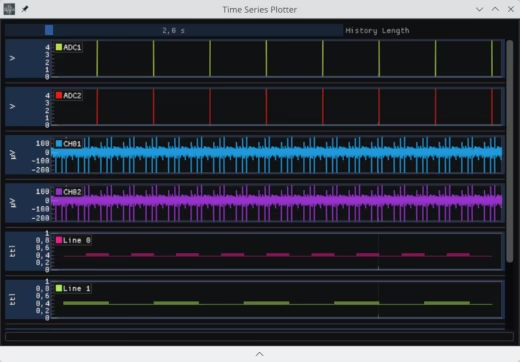
The live plotted signals in a Plot Time Series module may look like this:
Output Data Format
Sample data is published as SignalBlockU16. The
data_unit / data_scale / data_offset metadata keys describe how
to recover physical µV values — see Common Stream Metadata
for the contract. Display modules like
Plot Time Series apply the transform on the fly;
writer modules like Zarr Writer persist the keys so
recordings can be converted to µV after the fact.
Each connected headstage produces up to two output ports:
- an electrode port, and
- an AUX port, when AUX streaming is enabled.
A single board-wide ADC port (adc) is published when ADC streaming
is enabled. Ports that would have zero enabled channels are not
registered. Ports that survive a rescan keep their identity, so live
subscriptions on other modules are unaffected when an unrelated
headstage is replugged.
Ports
| Name | Direction | Data Type | Description |
|---|---|---|---|
| 🠺 TTL Triggers | In | LineCommand | Digital pulses to fire on the board’s TTL outputs. |
| Headstage | Out | SignalBlockU16 | Electrode samples for one headstage. |
| Headstage | Out | SignalBlockU16 | AUX channels for one headstage (when enabled). |
| Board ADC 🠺 | Out | SignalBlockU16 | Data from the on-board ADC inputs (when enabled). |
| TTL Input 🠺 | Out | LineReading | Data from the on-board TTL inputs (when enabled). |
Stream Metadata
All output ports carry the standard signal-stream metadata:
| Key | Value |
|---|---|
sample_rate | The configured sample rate, in Hz. |
time_unit | Always index. |
signal_names | Per-channel labels in the configured naming scheme. |
data_unit | µV (the unit after the affine transform). |
data_scale | The board’s per-LSB conversion factor for this channel kind. |
data_offset | 0.0. |
is_digital | true, only set for the digital TTL LineReading output. |